Case study · Open-source skill library
Obra Superpowers: fourteen skills, one disciplined workflow.
A visual map of the library, a commit-pinned SkillSpector pass for every skill, downloadable JSON evidence, and the archived research thread that started the review.
01
At a glance
14 skills as a framework for software development
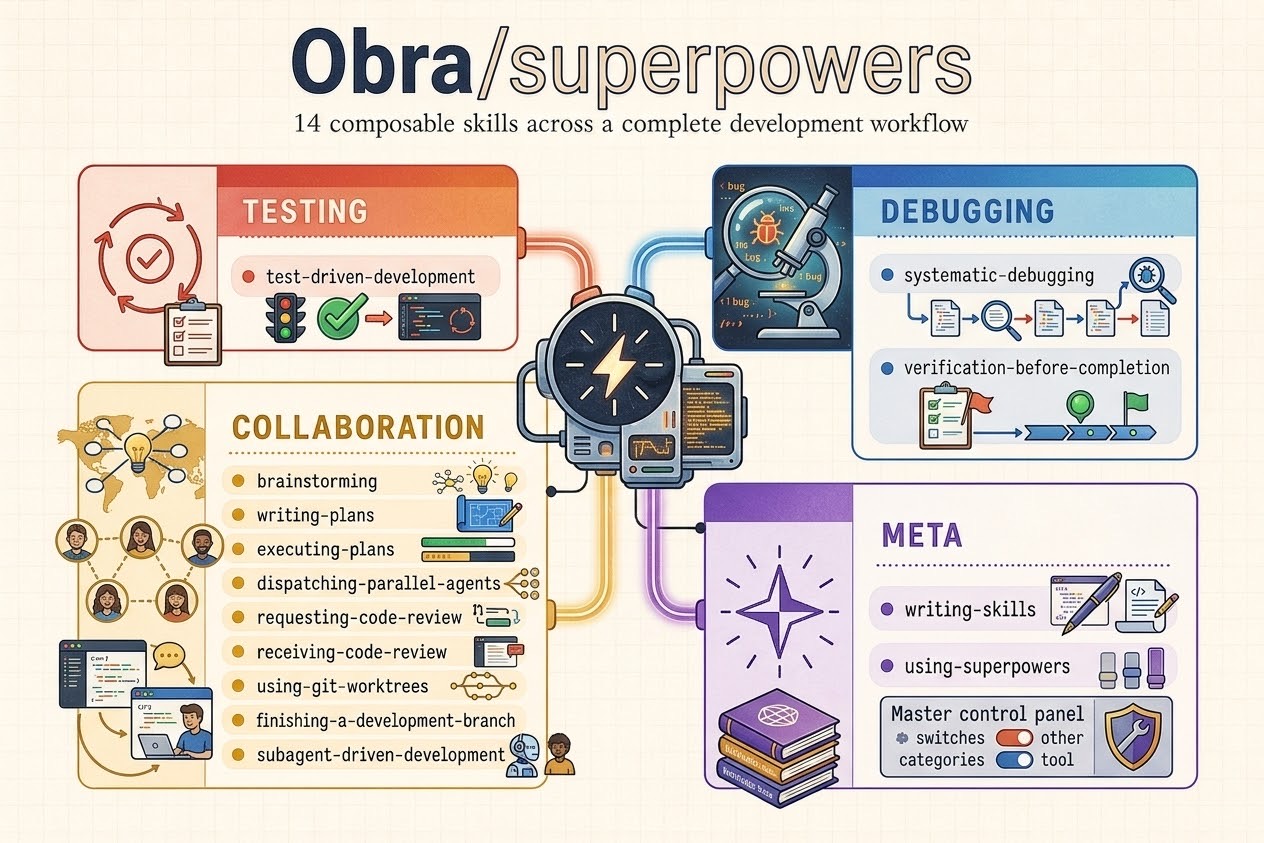
The repository’s skills/ directory contains 14 subdirectories with a SKILL.md. The README’s “What's Inside” section names the same set. The map below shows how those skills divide across four jobs: testing, debugging, collaboration, and meta-work.
02
Four categories, four kinds of leverage
| Category | What it contributes | Skills |
|---|---|---|
| Testing | Build a red-green-refactor loop into process documentation. | test-driven-development |
| Debugging | Find root causes, then verify that the fix is real. | systematic-debuggingverification-before-completion |
| Collaboration | Move from idea to plan, parallel execution, review, and branch finish. | brainstormingwriting-plansexecuting-plansdispatching-parallel-agentsrequesting-code-reviewreceiving-code-reviewusing-git-worktreesfinishing-a-development-branchsubagent-driven-development |
| Meta | Explain the skill system and teach people how to author it. | writing-skillsusing-superpowers |
These categories follow the repository README’s organization; they are descriptive groupings, not scanner risk categories.
03
Pre-install screen
Static analysis surfaced leads, not a verdict.
Each skill directory was scanned separately with NVIDIA SkillSpector 2.10.0 in static-only mode. The reports contain 46 findings across the 14 skills. Three skills reached the scanner's high or critical bands; all 14 reports are retained below as JSON.
One report per SKILL.md directory.
Across prompt, tool, privilege, agent, and data-flow categories.
brainstorming, systematic-debugging, and writing-skills.
This was a preliminary static screen. Semantic LLM analysis was not run, and the reports are marked partial because some local path-like references could not be resolved unambiguously. A passing or low score does not prove identity, runtime safety, dependency safety, or absence of vulnerabilities.
The companion OWASP high-signal regex triage found no matches for direct “ignore previous instructions,” developer-mode, system override, prompt-leakage, API-key, or numbered-instruction patterns. OWASP treats those expressions as leads, not clearance; indirect, encoded, persistent, and tool-mediated attacks still need human review.
04
Per-skill results, with the JSON beside them
Scores below reproduce the machine-readable results from the exact commit. Use the JSON link for finding IDs, locations, explanations, confidence values, analyzer status, and completeness details.
| Skill | Category | Score | Severity | Issues | JSON |
|---|---|---|---|---|---|
brainstorming | Collaboration | 80 | HIGH DO_NOT_INSTALL | 10 | View report |
dispatching-parallel-agents | Collaboration | 0 | LOW CAUTION | 0 | View report |
executing-plans | Collaboration | 8 | LOW CAUTION | 1 | View report |
finishing-a-development-branch | Collaboration | 17 | LOW CAUTION | 1 | View report |
receiving-code-review | Collaboration | 0 | LOW CAUTION | 0 | View report |
requesting-code-review | Collaboration | 7 | LOW CAUTION | 1 | View report |
subagent-driven-development | Collaboration | 23 | MEDIUM CAUTION | 2 | View report |
systematic-debugging | Debugging | 52 | HIGH DO_NOT_INSTALL | 4 | View report |
test-driven-development | Testing | 0 | LOW CAUTION | 0 | View report |
using-git-worktrees | Collaboration | 11 | LOW CAUTION | 2 | View report |
using-superpowers | Meta | 49 | MEDIUM CAUTION | 4 | View report |
verification-before-completion | Debugging | 7 | LOW CAUTION | 1 | View report |
writing-plans | Collaboration | 0 | LOW CAUTION | 0 | View report |
writing-skills | Meta | 89 | CRITICAL DO_NOT_INSTALL | 20 | View report |
The scanner’s low-score output still recommends CAUTION for this static-only run. That conservative label is preserved exactly; it is not rewritten as “safe.”
05
Human context
What the high scores appeared to be seeing
The scanner correctly points a reviewer toward sensitive surfaces, but its patterns do not understand intent on their own. A first context pass found these useful distinctions:
brainstorming: local companion-server lifecycle code uses background process management, state files, and asudo lsofcheck; an HTML comment was ordinary branding. Those are legitimate development-server behaviors that still deserve explicit permission and persistence review.systematic-debugging: credential and keychain commands appear in debugging examples, while instrumentation examples show logging. They are documentation leads, not confirmed credential theft or exfiltration, but real credentials should never be copied into the workflow.writing-skills: the skill teaches authoring, editing, testing, and enumerating other skills and agent configuration directories. That explains much of its high score, but it also makes least privilege and trust boundaries important for any skill-authoring workflow.- The remaining findings: most are process instructions about autonomous execution, branch operations, human checkpoints, or review verdicts. Those can be useful capabilities while still requiring a human gate for destructive commands, pushes, credentials, and broad file access.
Do not install or execute the three high/critical-scoring skills solely because this page includes their reports. Pair the static evidence with provenance, source review, least privilege, sandboxing, egress control, secret isolation, semantic assessment, and a deliberate human decision.
06
Origin story
The research thread that started this review
This guide also preserves the visible contents of the user-originated shared ChatGPT thread that asked whether Superpowers had been evaluated, how effective it was, and whether it worked equally well in Codex and Claude.
As an AI engineer, review the Obra superpowers skills (see GitHub). Has anyone online does evaluation or reviews of these skills? How effective are they? Are they equally useful for Codex as well as Claude?
The archived response’s central conclusion was selective use: Superpowers is best understood as an agentic software-development operating procedure, with its strongest value in process discipline rather than proven model intelligence. It described Claude Code as the more native target, while treating Codex as a viable but more explicit environment for subagent-heavy workflows.
| Workflow | Claude Code | Codex | Thread recommendation |
|---|---|---|---|
brainstorming | High | High | Use for vague feature ideas before coding. |
systematic-debugging | High | High | Use for bugs where the cause is unknown. |
verification-before-completion | High | High | Use almost always; low ceremony and high value. |
using-git-worktrees | High | High, especially Codex app | Use for risky changes or parallel tasks. |
test-driven-development | High | Medium-high | Use when tests are cheap and meaningful. |
writing-plans | Medium-high | Medium | Use for multi-file work; avoid for small edits. |
subagent-driven-development | High but expensive | Medium-high but more explicit | Use for complex work; expect token/runtime overhead. |
requesting-code-review | High | High | Use before merging or after broad changes. |
writing-skills | High for skill authors | High for skill authors | Useful for building reusable workflows. |
The full visible prompt and response—including its evidence table, caveats, recommendations, and linked sources—is preserved as a readable Markdown transcript. Read the archived transcript or open the original share page.
The transcript is historical source material, not an independent benchmark or a replacement for the commit-pinned static review above. Product documentation and research claims can change.
Sources and audit files
- Obra Superpowers repository
- Exact reviewed commit: b36e0829c6d0140e93cfef2ca599b1b07d4a7797
- Machine-readable audit index
- OWASP regex triage record
- Archived shared-thread transcript
- NVIDIA SkillSpector
- OWASP LLM Prompt Injection Prevention Cheat Sheet
- Superpowers behavioral eval harness
- SWE-Skills-Bench
The raw reports are preliminary static evidence. SkillSpector does not prove publisher identity, artifact integrity, runtime safety, dependency resolution, or the absence of vulnerabilities.