Case study · Open-source skill library
Matt Pocock’s Skills for Real Engineers: all 37 reviewed.
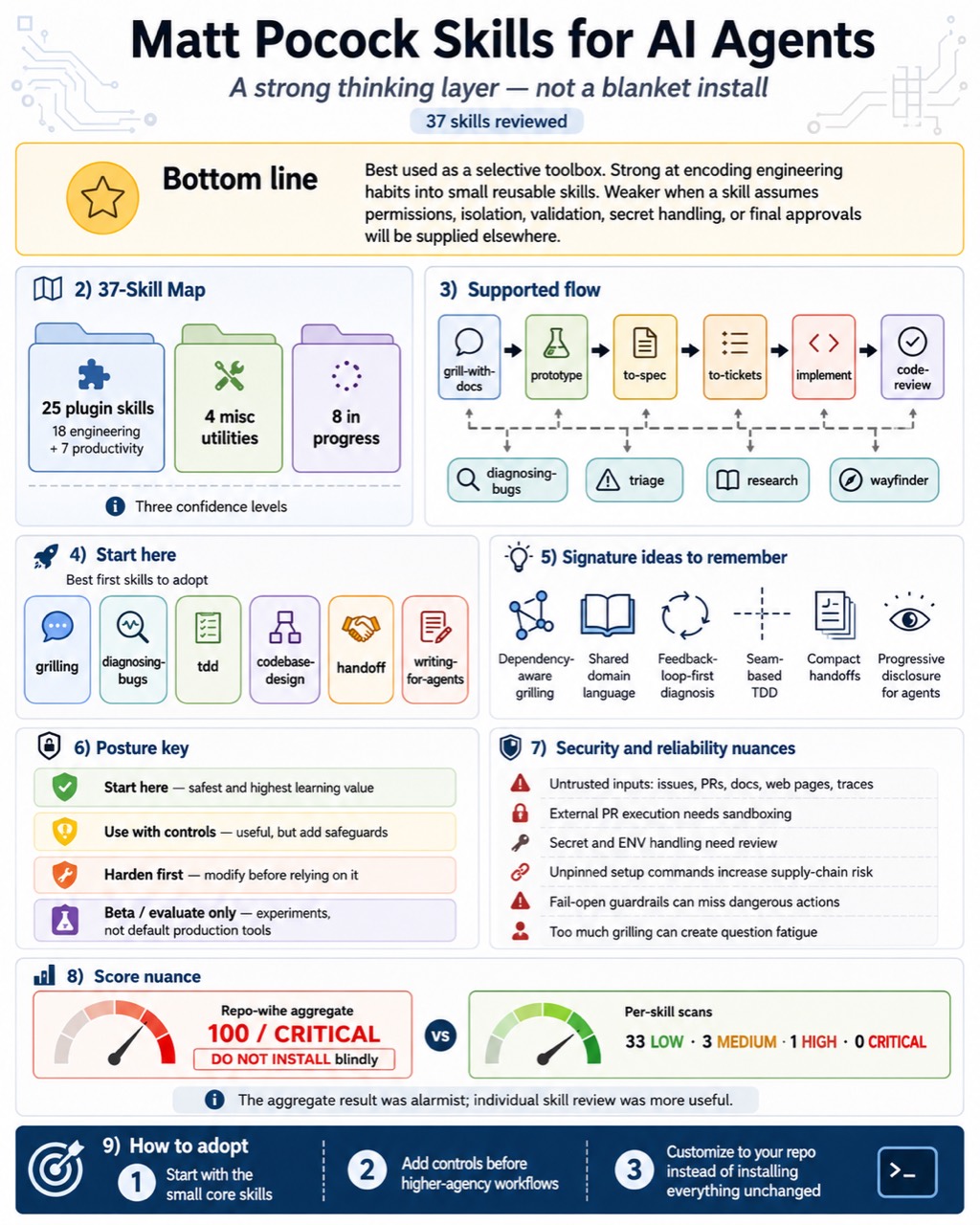
The collection’s best ideas are its smallest ones: dependency-aware grilling, shared domain language, feedback-loop-first diagnosis, seam-based TDD, and compact handoffs. Adopt those selectively. The higher-agency tracker, secret, shell, and parallel-agent workflows need stronger controls than their prose currently supplies.
01
Independent assessment
A strong thinking layer, not a blanket install.
This collection is more interesting than a prompt pack and less complete than a development framework. Its strongest skills compress good engineering habits into narrow, editable procedures. Its weakest skills assume the host agent will supply permissions, isolation, input validation, secret handling, and final approvals that the skill itself does not enforce.
Start with grilling, diagnosing-bugs,tdd, codebase-design, handoff, and writing-for-agents. Adapt the tracker and implementation flows to your repository. Do not deploygit-guardrails-claude-code or wizardunchanged, and keep the eight in-progress skills out of a default production bundle.
That selective posture also matches the repository’s stated design: small, composable skills that engineers can edit rather than a system that owns the whole process.
02
One repository, three confidence levels
All 37 previously catalogued SKILL.md entrypoints still resolve at the current pin. Thirty-six are byte-for-byte identical to the deeper August 24 review; retro is the only changed entrypoint. The 25 plugin, four misc, and eight in-progress groupings below come from the fully inventoried6654f6b60cd9 snapshot.
18 engineering workflows plus seven productivity primitives form the supported collection.
Useful but stack-specific setup and migration helpers that are not part of the plugin manifest.
Public experiments that the repository says can change or disappear without warning.
The supported flow is modular rather than mandatory: grill-with-docs → prototype → to-spec → to-tickets → implement → code-review. Bug diagnosis, triage, research, and wayfinding enter from the side when the situation calls for them.
Scope limit: the current whole-repository archive was rejected because it contains a link or special entry. The current count therefore confirms the same 37 known entrypoints, but does not prove that no new skill directory was added elsewhere.
03
Pre-install screen
The fresh result is useful because its scope is explicit.
The latest Docker-isolated review resolved the default branch to 959a8e9f1edc3adbe2f7e3054bb6fbefa6696260, then acquired each known entrypoint at that exact commit through a restricted broker. SkillSpector 2.11.2 ran with no network, no host mount, no Docker socket, dropped capabilities, a read-only root filesystem, and no target code execution. No baseline or suppression was applied.
Every previously catalogued SKILL.md was fetched and scanned at 959a8e9f1edc.
Thirty-six entrypoints scored LOW; git-guardrails-claude-code scored 50 / MEDIUM. None scored HIGH or CRITICAL.
Twenty-one were partial because a single-file scan cannot resolve every companion file. Partial means incomplete context, not unsafe or safe.
- Stable entrypoint evidence: 36 of 37 current files have the same SHA-256 as the prior pin. Their earlier local semantic review still describes the exact bytes scanned now.
- Changed file:
retrochanged and received a fresh static scan only. Its older semantic note is retained as historical context, not a fresh independent audit. - Static noise remains: ordinary phrases in
grilling,to-questionnaire, andto-ticketsstill produce low-severity pattern findings. The Git deny-list also produces contextual matches, while its 50 / MEDIUM result remains visible. - One OWASP lead:
diagnosing-bugsmatched a secret-request expression. Manual review at the identical file hash found a redaction-oriented human prompt helper, not a request to expose a secret.
The fresh static result belongs to 959a8e9f1edc3adbe2f7e3054bb6fbefa6696260. The complete support-file and local semantic review belongs to6654f6b60cd9d5be8b54c6fafe44346dabeb3b76. Thirty-six entrypoint hashes bridge those reviews; support-file conclusions do not carry forward unless the current support artifact was independently confirmed. SkillSpector’s integrated LLM layer was not used, no repository script ran, and no raw artifact was sent to an external semantic reviewer.
04
Registry evidence · September 15, 2026
Third-party audits mostly support the review, but they do not share its pin.
The skills.sh cross-check loaded all 37 listings and all 111 detailed audit pages from Gen Agent Trust Hub, Socket, and Snyk. A conservative roll-up produced 29 passes, seven warnings, and one failure. Trust Hub reported 34 pass and three warn; Socket reported 36 pass and one warn; Snyk reported 31 pass, five warn, and one fail. These are registry verdicts for provider-selected packages; none proved exact correspondence to either reviewed Git commit or raw SKILL.md hash.
Provider detail reinforces a local concern or false-positive adjudication.
All providers passed while the pinned local review found a narrower behavior they did not test.
The registry verdict addresses a different question or provides too little detail to compare.
- Strong support: triage is warned for checking out and running external pull-request code plus indirect prompt injection; this directly supports the local remote-code-execution concern.
- Strong support: code-review receives Trust Hub warnings and the only Snyk failure, covering untrusted diffs/specs, command input, and verbatim secret reproduction.
- Additional support: the providers reinforce runtime-CDN concerns in
improve-codebase-architecture, outsider-content risk inresolving-merge-conflicts, tracker ingestion into-ticketsandwayfinder, and command/prompt injection inclaude-handoff. - Meaningful disagreement: all three providers pass git-guardrails-claude-code,
setup-pre-commit, andwizard. The local review tests narrower properties—fail-open command matching, package lifecycle and resolution controls, and secret/path serialization—that the registry reports do not discuss.
Freshness also differs: 21 registry audits predate the deeper review pin and 16 postdate it. “Supports” and “contradicts” mean comparison of stated findings, not proof that both scanners saw the same artifact.
05
All 18 engineering skills, individually reviewed
Open each review for purpose, strongest contribution, weakness, pinned source, and its individual static score. Posture is the human recommendation, not a relabeled scanner verdict.
ask-mattUse with controls
Routes a situation into the collection’s idea-to-ship, bug, triage, research, or long-horizon flow.
Strength: The phase-boundary guidance is unusually useful: it distinguishes continuation, fresh context, handoff, subagents, and compaction instead of treating every task alike.
Weakness / risk: It assumes companion skills are installed and current, and it routes credentials work to wizard and conflicts to a resolver whose never-abort rule is too aggressive. Treat its route as advice, not authority.
SkillSpector 2.11.2 at 959a8e9f1edc: 0 / LOW. Open the pinned skill
code-reviewUse with controls
Reviews a fixed-point diff on two independent axes: repository standards and faithfulness to the originating specification.
Strength: Validating the comparison point first and separating Standards from Spec prevents a clean-looking diff from masking the wrong implementation.
Weakness / risk: Issue text, commit messages, PR material, and diffs are passed to subagents without an explicit instruction/data boundary. Add secret redaction, tool-disabled reviewers, and output screening; add a separate security review when needed.
SkillSpector 2.11.2 at 959a8e9f1edc: 0 / LOW. Open the pinned skill
codebase-designStart here
Supplies a shared vocabulary and heuristics for deep modules, seams, interfaces, leverage, and locality.
Strength: The deletion test, interface-as-test-surface rule, dependency categories, and Design It Twice exercise are compact, memorable engineering tools.
Weakness / risk: Its vocabulary and one-adapter/two-adapter heuristic can become dogma. Keep the concepts, but let established team language and real isolation requirements win.
SkillSpector 2.11.2 at 959a8e9f1edc: 0 / LOW. Open the pinned skill
diagnosing-bugsStart here
Builds a deterministic red feedback loop, minimizes the failure, tests falsifiable hypotheses, instruments one variable, fixes, and regression-tests.
Strength: This is the collection’s best operational discipline: reproduce before theorizing, preserve a regression at the right seam, then remove throwaway instrumentation.
Weakness / risk: Curl, trace replay, bisection, fuzzing, stress, and temporary production instrumentation need environment, rate, and authorization controls. Its OWASP secret-request lead is a contextual false positive at the identical file hash, but captured logs still need redaction.
SkillSpector 2.11.2 at 959a8e9f1edc: 0 / LOW. Open the pinned skill
domain-modelingUse with controls
Sharpens a repository glossary and records only durable, consequential decisions as ADRs.
Strength: It turns project language into a persistent asset and tests that language against edge cases and the actual code rather than accepting a glossary at face value.
Weakness / risk: CONTEXT.md and ADRs become trusted future-agent memory. Require a human diff review, avoid concurrent writes, and do not let repository text silently become instructions.
SkillSpector 2.11.2 at 959a8e9f1edc: 0 / LOW. Open the pinned skill
grill-with-docsUse with controls
Combines the reusable grilling interview with domain-modeling so clarified terms and decisions survive the chat.
Strength: The combination attacks two real failure modes at once: underspecified work and vocabulary that evaporates between sessions.
Weakness / risk: The wrapper itself is only a few lines and leaves ordering, failure behavior, and child-skill tool boundaries implicit. Its quality and safety are almost entirely transitive.
SkillSpector 2.11.2 at 959a8e9f1edc: 0 / LOW. Open the pinned skill
implementHarden first
Implements a spec or ticket, uses TDD at pre-agreed seams, runs checks, reviews, and commits.
Strength: It is admirably small and keeps implementation tied to tests and a final two-axis review.
Weakness / risk: The prose authorizes arbitrary repository commands and a commit without a clean-tree check, branch isolation, scope review, or final approval. Use an isolated worktree and review the exact staged diff before committing.
SkillSpector 2.11.2 at 959a8e9f1edc: 0 / LOW. Open the pinned skill
improve-codebase-architectureUse with controls
Surveys a codebase for deepening opportunities, presents candidates visually, and interviews the user about the selected change.
Strength: It explores before prescribing, requires file-level evidence, and delays interface design until the user chooses a candidate.
Weakness / risk: The generated HTML imports unpinned Tailwind and Mermaid assets, uses loose Mermaid security, opens a local file, and may persist CONTEXT.md changes. Escape repository data and use local or pinned assets.
SkillSpector 2.11.2 at 959a8e9f1edc: 0 / LOW. Open the pinned skill
prototypeUse with controls
Builds a deliberately throwaway logic or UI prototype to answer one design question.
Strength: It distinguishes logic from UI exploration, insists on genuinely different variants, and clearly separates prototype code from production promotion.
Weakness / risk: Existing-route UI prototypes may retain real authentication and data access while intentionally omitting tests and error handling. Use sanitized fixtures and rewrite promoted code.
SkillSpector 2.11.2 at 959a8e9f1edc: 0 / LOW. Open the pinned skill
researchUse with controls
Delegates a question to a background researcher and saves a claim-cited Markdown artifact in the repository.
Strength: It favors primary sources and durable, claim-level citations instead of letting research disappear into a chat transcript.
Weakness / risk: Remote pages and source code are indirect-prompt-injection surfaces, and a background agent writes persistent content. Bound the domains and tools, separate source text from instructions, and review the artifact.
SkillSpector 2.11.2 at 959a8e9f1edc: 0 / LOW. Open the pinned skill
resolving-merge-conflictsHarden first
Resolves merge or rebase conflicts by reconstructing each side’s intent from code history and source artifacts.
Strength: Intent-first conflict resolution is much better than blindly choosing ours or theirs.
Weakness / risk: Always resolve; never abort removes a valuable recovery path, and the skill stages and commits without a hard approval gate. Capture a backup ref, isolate the work, retain abort, and review staging.
SkillSpector 2.11.2 at 959a8e9f1edc: 0 / LOW. Open the pinned skill
setup-matt-pocock-skillsUse with controls
Configures issue-tracker conventions, triage labels, and domain-document layout for the rest of the engineering collection.
Strength: It explores first, supports GitHub, GitLab, local Markdown, and custom trackers, and tries to preview persistent files before writing.
Weakness / risk: It modifies AGENTS.md or CLAUDE.md and durable tracker instructions. A single-context default may be written without asking despite the later preview step. Treat the generated files as security-sensitive configuration.
SkillSpector 2.11.2 at 959a8e9f1edc: 7 / LOW. Open the pinned skill
tddStart here
Runs behavior-first red-green-refactor through a public seam, with boundary-only mocking and independently derived expected values.
Strength: It is clear, portable, and opinionated in productive ways about observable behavior and meaningful tests.
Weakness / risk: One seam and one test can be too rigid for properties, security tests, or mature suites. Repository test commands are executable code, so use normal sandbox and trust controls.
SkillSpector 2.11.2 at 959a8e9f1edc: 0 / LOW. Open the pinned skill
to-specUse with controls
Synthesizes an existing conversation into a problem statement, stories, scope, domain terms, and test seams, then publishes it to the configured tracker.
Strength: It preserves the reasoning already completed instead of restarting discovery, and its template is stronger than a generic PRD shell.
Weakness / risk: No interview conflicts with its seam-confirmation requirement, and publication lacks a separate final confirmation. Preview, redact, and approve before tracker writes.
SkillSpector 2.11.2 at 959a8e9f1edc: 0 / LOW. Open the pinned skill
to-ticketsUse with controls
Slices a spec into tracer-bullet tickets with explicit blocking edges and an approval loop.
Strength: Vertical slices plus a dependency graph make the resulting work much more executable than a flat checklist; its expand-contract exception is thoughtful.
Weakness / risk: External issues and comments are ingested as if trusted. The scanner’s tool-chaining hit is a false positive about refactor sequencing, but ticket text still needs sanitization and a final publish gate.
SkillSpector 2.11.2 at 959a8e9f1edc: 17 / LOW. Open the pinned skill
triageHarden first
Moves issues through a documented state machine and separates agent-ready work from human-only decisions.
Strength: The role labels, AI-comment disclaimer, redundancy checks, and maintainer recommendation gate are well designed.
Weakness / risk: The external-PR path checks out contributor code and runs its commands without first requiring isolation and a trust decision. Limit it to read-only issue triage unless the PR is sandboxed and explicitly approved.
SkillSpector 2.11.2 at 959a8e9f1edc: 0 / LOW. Open the pinned skill
wayfinderUse with controls
Maps a body of work too large for one context window as decision tickets and resolves the ready frontier over time.
Strength: Destination-first scope, fog-of-war tickets, native dependency edges, and claim-before-work rules make it a credible long-horizon planning system.
Weakness / risk: Research results and tracker content are untrusted, remote writes need confirmation, and tickets should never contain credentials or secret locations. It is useful, but not lightweight.
SkillSpector 2.11.2 at 959a8e9f1edc: 0 / LOW. Open the pinned skill
wizardHarden first
Generates an interactive Bash wizard for human-only setup, credential, dashboard, migration, and cutover steps.
Strength: The intended experience is excellent: visible stages, hidden secret input, confirmation before irreversible actions, static tracing, and no unattended end-to-end run.
Weakness / risk: The template opens unvalidated URLs, reads and writes arbitrary ENV_FILE paths, interpolates keys into regexes, accepts newline-containing values, inherits ambient file permissions, and can continue on EOF. Harden secret handling before use.
SkillSpector 2.11.2 at 959a8e9f1edc: 0 / LOW. Open the pinned skill
06
The other 19: productivity, misc, and public experiments
Seven productivity skills
grill-meStart here
Provides a memorable manual entry point into the reusable grilling interview.
Strength: Its simplicity is the point: discovery stays explicit and the interviewing logic remains centralized.
Weakness / risk: It defines almost no contract of its own and assumes grilling is present. The value is discoverability, not independent capability.
SkillSpector 2.11.2 at 959a8e9f1edc: 0 / LOW. Open the pinned skill
grillingStart here
Maps a plan or decision as a dependency-aware design tree and asks the currently answerable frontier in rounds.
Strength: Separating discoverable facts from user-owned decisions, while attaching a recommendation to each question, is the collection’s signature idea.
Weakness / risk: Relentless can become endless. There is no round budget or stopping rule beyond an empty frontier, and fact-finding subagents need read-only scope. The scanner’s autonomy hit is a contextual false positive.
SkillSpector 2.11.2 at 959a8e9f1edc: 8 / LOW. Open the pinned skill
handoffStart here
Writes a compact, purpose-specific conversation handoff into the operating system’s temporary directory.
Strength: It avoids copying durable specs, issues, ADRs, commits, and diffs, and explicitly requires secret and PII redaction.
Weakness / risk: The temporary filename, permissions, collision behavior, retention, and cleanup are unspecified. Add deterministic naming and restrictive permissions.
SkillSpector 2.11.2 at 959a8e9f1edc: 0 / LOW. Open the pinned skill
teachUse with controls
Creates a stateful teaching workspace with missions, lessons, retrieval practice, sources, learning records, and reusable HTML assets.
Strength: It has a serious learning model: spacing, retrieval, interleaving, durable records, and a zone-of-proximal-development lens.
Weakness / risk: HTML lessons create an active-content surface, learning records can be private, and opening files or joining communities crosses boundaries. Sanitize content and ask before external actions.
SkillSpector 2.11.2 at 959a8e9f1edc: 0 / LOW. Open the pinned skill
to-questionnaireUse with controls
Turns a knowledge gap into a one-pass questionnaire for the specific person who can answer it.
Strength: Grill the send, not the subject is an excellent constraint: it keeps the user’s burden low and targets the missing decisions directly.
Weakness / risk: It writes to the current directory without destination, collision, or privacy checks. The scanner’s “always answer” hit is an ordinary-language false positive.
SkillSpector 2.11.2 at 959a8e9f1edc: 17 / LOW. Open the pinned skill
wait-whatStart here
Re-pitches a confusing message with the missing context, plain language, and repository vocabulary.
Strength: It is a tiny, high-leverage recovery command that asks the agent to restore context rather than merely repeat itself.
Weakness / risk: It assumes valid CONTEXT files and gives no fallback when they are missing or contradictory. Ask the rewrite to state what changed.
SkillSpector 2.11.2 at 959a8e9f1edc: 0 / LOW. Open the pinned skill
writing-for-agentsStart here
Offers a theory for writing skills, AGENTS.md or CLAUDE.md, and other documents that agents consume.
Strength: Context load versus cognitive load, progressive disclosure, context pointers, completion criteria, and the no-op test form a coherent authoring framework.
Weakness / risk: Claims about model priors, negation, and leading words are useful hypotheses, not established laws. Pair the advice with behavioral tests and explicit tool-security guidance.
SkillSpector 2.11.2 at 959a8e9f1edc: 0 / LOW. Open the pinned skill
Four misc utilities
git-guardrails-claude-codeHarden first
Installs a Claude Code PreToolUse hook intended to block destructive Git commands.
Strength: The defensive goal and project-versus-global scope question are right.
Weakness / risk: The scanner’s dangerous-command hits mostly quote a deny-list, but the real script is fail-open lexical matching: it misses aliases, indirection, alternate destructive commands, and malformed JSON. Do not deploy it unchanged; use structured parsing, allowlisting, and bypass tests.
SkillSpector 2.11.2 at 959a8e9f1edc: 50 / MEDIUM. Open the pinned skill
migrate-to-shoehornUse with controls
Replaces unsafe TypeScript test casts with ShoeHorn’s partial-object helpers.
Strength: It is narrow, legible, and distinguishes intentionally unsafe negative-test construction from ordinary fixtures.
Weakness / risk: The package install is unpinned, grep discovery is fragile, and fromAny deliberately bypasses type safety. Review every cast and run the full test suite.
SkillSpector 2.11.2 at 959a8e9f1edc: 0 / LOW. Open the pinned skill
scaffold-exercisesHarden first
Creates or reorganizes exercise folders under a project-specific course convention.
Strength: Naming, required files, linter integration, and move-versus-rename rules are concrete.
Weakness / risk: Plan-derived paths feed filesystem operations and the skill commits unconditionally. Validate paths, preview the tree, inspect project commands, and ask before staging or committing.
SkillSpector 2.11.2 at 959a8e9f1edc: 0 / LOW. Open the pinned skill
setup-pre-commitHarden first
Installs Husky, lint-staged, and Prettier, then wires repository checks into a pre-commit hook.
Strength: The sequence is practical and adapts to an existing formatter and package manager.
Weakness / risk: Unpinned npx commands are a real supply-chain lead, repository scripts and lifecycle hooks execute code, and “stage all” can capture unrelated work. Pin tools and review the exact diff and staged set.
SkillSpector 2.11.2 at 959a8e9f1edc: 12 / LOW. Open the pinned skill
Eight in-progress skills
These are intentionally outside the plugin. A low static score does not change their upstream beta status.
claude-handoffBeta: evaluate only
Summarizes the current work and launches a fresh Claude background agent to continue immediately.
Strength: It emphasizes redaction and references durable artifacts instead of stuffing the entire project into a new prompt.
Weakness / risk: The handoff is placed in a command-line argument, risking process-list exposure and quoting injection. Use a protected file or stdin and require approval before background execution.
SkillSpector 2.11.2 at 959a8e9f1edc: 0 / LOW. Open the pinned skill
implement-specBeta: evaluate only
Implements a ticket graph in parallel worktrees, merges the branches, reviews the whole change, opens a draft PR, and cleans up.
Strength: The ready-frontier model, sparse context pointers, isolated worktrees, and final merge review form a serious execution design.
Weakness / risk: It is the pack’s highest-autonomy workflow: branches, subagents, commands, merges, PR and issue effects, and cleanup need a human-approved plan, bounded concurrency, sandboxing, and final diff review.
SkillSpector 2.11.2 at 959a8e9f1edc: 0 / LOW. Open the pinned skill
loop-meBeta: evaluate only
Turns recurring personal or work loops into stateful workflow specifications under workflows/.
Strength: Trigger, checkpoint, push right, and decision-ready brief are useful vocabulary, and the skill avoids forcing AI or schedules where they do not belong.
Weakness / risk: The workflow schema is underspecified, while create, edit, and delete operations lack recovery or confirmation rules. Confirm before deleting or materially rewriting existing specs.
SkillSpector 2.11.2 at 959a8e9f1edc: 7 / LOW. Open the pinned skill
retroBeta: evaluate only
Reviews a completed coding session for improvements to navigation, checks, standards, instructions, tools, and information access.
Strength: It correctly asks which information should be a pointer, automated check, standard, or no-op instead of expanding always-loaded instructions by default.
Weakness / risk: It searches session logs without a defined consent, scope, or redaction boundary and does not clearly forbid direct environment changes. Keep it recommendation-only.
SkillSpector 2.11.2 at 959a8e9f1edc: 0 / LOW. Open the pinned skill
setup-ts-deep-modulesBeta: evaluate only
Installs dependency-cruiser and enforces flat TypeScript packages whose subfolders are private behind root entry points.
Strength: The pass-fail-pass proof is excellent, the supplied rules are readable, and existing configuration is meant to be merged rather than replaced.
Weakness / risk: The layout heuristics are opinionated, the dependency is unpinned, verification temporarily breaks a test file, and many project files change. The fresh entrypoint scan is partial because its companion configuration was outside the exact-file scope; the older pinned support-file review found a declarative config, not executable misbehavior.
SkillSpector 2.11.2 at 959a8e9f1edc: 0 / LOW. Open the pinned skill
writing-beatsBeta: evaluate only
Shapes an article as a user-directed journey, writing one reachable beat at a time from fixed raw material.
Strength: Prerequisites, grounded concepts, reachable next beats, and one-beat writes give the author unusually tight control.
Weakness / risk: It is turn-intensive, grounding state is not persisted, and raw material has no citation or prompt-injection boundary. Keep provenance with the source pile.
SkillSpector 2.11.2 at 959a8e9f1edc: 0 / LOW. Open the pinned skill
writing-fragmentsBeta: evaluate only
Mines a conversation for heterogeneous fragments without prematurely forcing an outline.
Strength: The explore-versus-exploit distinction and append-oriented file discipline preserve raw material and user edits.
Weakness / risk: Silent appends reduce transparency, the file can grow without provenance or an exit condition, and sensitive conversation material may be retained. Show writes and label sources.
SkillSpector 2.11.2 at 959a8e9f1edc: 0 / LOW. Open the pinned skill
writing-shapeBeta: evaluate only
Turns a read-only pile of raw material into a separate article one paragraph or block at a time.
Strength: It protects the source, exposes format trade-offs, names missing evidence, and re-reads before each incremental write.
Weakness / risk: The interaction is expensive, grounding is chat-local, and quoting or paraphrasing lacks attribution checks. Add provenance and treat the pile as untrusted data.
SkillSpector 2.11.2 at 959a8e9f1edc: 0 / LOW. Open the pinned skill
Count check: 37 individual reviews. Scores are from exact-file SkillSpector 2.11.2 static scans at 959a8e9f1edc; local semantic judgment at the separately named baseline pin determines the posture.
07
External signal, carefully weighted
Reviewers praise the primitives and complain about the same edge: too much grilling.
Online material is noisy and often describes earlier versions with renamed skills. The most useful sources are concrete adoption notes and upstream issues, not star counts or launch summaries.
- Adopt with adaptation: Rhi’s running review kept the architecture vocabulary, exploration gate, inline context updates, and Design It Twice pattern, while dropping ADR ceremony and TypeScript-specific pieces that did not fit its environment.
- Strongest independent praise: Kaizen Craft’s critical guide singled out feedback-loop-first diagnosis and the no-op/context-load theory in the earlier writing skill, while warning that much of the wording is self-reported methodology rather than evaluated performance.
- Upstream friction: GitHub issue #247 reports a 12-hour grilling session; issue #853 reports 40–50 questions, context compaction and spec drift; issue #797 asks for hypothesis-led confirmation to reduce question count.
- Superpowers comparison is anecdotal: one Reddit comparison thread reports higher token burn with Superpowers and better edge-case discovery with
grill-me; replies recommend taking only one or two useful skills and customizing them.
My inference from the source and the reviews: the pack’s durable value lies in engineering vocabulary and decision structure, not magic prompt phrasing. Its effectiveness will vary with model strength, repository context, tool controls, and the user’s willingness to answer and curate.
08
Matt Pocock versus Obra Superpowers
The two collections overlap on discovery, planning, TDD, debugging, review, and multi-agent work. They make different bets about how much of the lifecycle should be mandatory.
| Dimension | Matt Pocock | Obra Superpowers |
|---|---|---|
| Operating model | Selective toolbox; most orchestration skills are manually invoked. | Integrated development methodology; using-superpowers makes skill checking part of the default operating procedure. |
| Reviewed surface | 37 directories: 25 plugin skills, four misc utilities, eight explicitly in-progress skills. | 14 tightly connected skills in the Resource Library’s pinned review. |
| Best discovery work | Grilling, domain language, ADR capture, architecture vocabulary, and long-horizon decision mapping. | Brainstorming that feeds directly into plans and the execution lifecycle. |
| Best execution work | TDD and diagnosis are strong; parallel implementation exists but is still in progress. | Worktrees, subagent-driven development, plan execution, review, branch finishing, and verification are more mature as a system. |
| Control and ceremony | Easier to adopt one skill, edit it, and stop. More assembly and local configuration are left to the engineer. | More consistent guardrails and handoffs, but more process, context, subagents, and opportunities for token overhead. |
| Best fit | Experienced engineers who want sharp thinking tools and retain control of their existing workflow. | Teams or individuals who want a repeatable end-to-end coding operating procedure. |
Use Matt’s grilling, domain-modeling,diagnosing-bugs, and architecture vocabulary with Superpowers-style worktree isolation, explicit plan execution, verification-before-completion, and branch finishing. Remove duplicate brainstorming, planning, TDD, and review rules instead of stacking both collections whole.
The Resource Library’s Obra review used SkillSpector 2.10.0 at a different commit and scope. Its 14 reports and 46 findings are useful context, not a numerical risk benchmark against this 2.11.2 review.
09
Tertiary recommendation
Use suppression to preserve signal, never to manufacture agreement.
SkillSpector can generate a baseline, remove matching findings before scoring, and retain suppressed items in machine-readable output. Its suppression guide supports exact v2 fingerprints and broader rule, path, and message globs. This review intentionally applied none, so the figures above remain the raw scanner result.
- Keep rawPublish the unsuppressed report first. A suppressed score is a triage view, not the canonical security result.
- Own the baselineStore a reviewer-controlled baseline outside the third-party artifact. Do not trust or auto-apply a baseline shipped by the skill author.
- Suppress narrowlyPrefer an exact v2 fingerprint for one adjudicated false positive. Avoid broad rule-family globs, because source drift can turn a benign phrase into a materially different finding.
- Record whyEach entry should name the pin, scanner version, finding, rationale, reviewer, review date, and expiry or re-review trigger.
- Show the recordRun the triaged view with
--show-suppressed; suppressed findings remain excluded from the score but visible to reviewers. - Reconcile separatelyUse registry audits to challenge the adjudication. Do not suppress a local finding merely because Socket, Snyk, or Trust Hub passed it, and do not add a suppression to force matching totals.
The ordinary-language hits in grilling,to-questionnaire, and to-tickets, plus the redaction-oriented phrase in diagnosing-bugs, are candidates for exact, documented fingerprints after a fresh manual check. The git-guardrails-claude-codedeny-list matches should remain visible until the companion script’s fail-open behavior is revalidated at the same pin.
10
Adopt one behavior at a time.
- PinChoose an exact commit and one skill directory, not the mutable whole-repo default.
- ReadInspect SKILL.md and every referenced script, template, asset, tracker contract, and package command.
- BoundDefine allowed files, network domains, tracker targets, commands, secrets, and approval points.
- AdaptReplace assumptions that do not fit your stack. Add instruction/data separation and safe failure behavior.
- TrialUse a non-sensitive branch or worktree, record runtime and token cost, and compare with your ordinary workflow.
- KeepRetain only behavior that measurably improves decisions, defects, speed, or handoff quality. Re-scan updates.
The collection is worth reading even if you install none of it. Its best contribution is a vocabulary for making agent-assisted engineering less vague. Its weakest assumption is that good prose can substitute for enforced permissions and runtime guardrails. It cannot.
Sources
- Matt Pocock’s skills repository
- Exact static-scan pin: 959a8e9f1edc3adbe2f7e3054bb6fbefa6696260
- Exact support-file and semantic-review pin: 6654f6b60cd9d5be8b54c6fafe44346dabeb3b76
- Machine-readable evidence index
- NVIDIA SkillSpector
- SkillSpector suppression documentation
- skills.sh Matt Pocock collection
- OWASP LLM Prompt Injection Prevention Cheat Sheet
- Rhi: running skill-by-skill review
- Kaizen Craft: critical guide
- Issue #247: grilling severity
- Issue #853: long interviews and context compaction
- Issue #797: hypothesis-led confirmation request
- Reddit: Superpowers or Matt Pocock discussion
- Resource Library: Obra Superpowers review
SkillSpector is a preliminary static precaution. It does not prove publisher identity, artifact integrity, dependency resolution, runtime safety, model behavior, or the absence of false positives and false negatives. Online reviews are practitioner evidence, not controlled benchmarks.